
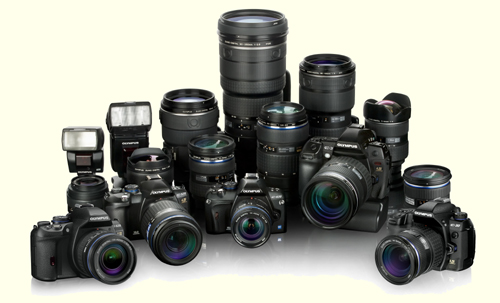
OLYMPUS DIGITAL SLR PHOTOGRAPHY
bodies * lenses * flashes * accessories
* printing * documentation * flash cards
|
OLYMPUS DIGITAL SLR PHOTOGRAPHY bodies * lenses * flashes * accessories * printing * documentation * flash cards
|
BODIES
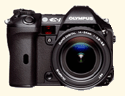
E-System E-1: The world's first true DSLR camera (Discontinued) |
To see more click the body icon. |
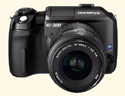
E-300 8MP (Discontinued) |
The pressure on Olympus to increase their pixel count intensified during 2004. It was inevitable that a response would follow. Sure enough, later in the year the E-300 was announced with a Kodak imager of 8.8MP utilising 8MP. However, this time the critics weren't happy with the design - a flat-topped and unusual look brought about by using a Porro system rather than a prism. However it sells well regardless. To see more click the body icon. |
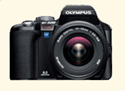
E-500 - 8MP (Discontinued) |
In a surprise move in September 2005 Olympus caught everyone off-guard by announcing another DSLR. Most observers expected a replacement for the E-1 but instead the E-500 was announced. This time Olympus addresses the criticism over the rather ugly E-300 with a more conventional (but not true prism) type DSLR. With virtually identical specifications to the E-300 it challenges the lower end offerings from Canon and Nikon. The E-500 is selling like hot cakes! To see more click the body icon. |
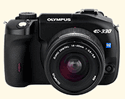
E-330 - 7.4MP & Live-View (Discontinued) |
To demonstrate that innovative thinking is alive and well and living at Olympus Imaging, Japan, the company announced in Spring of 2006 the E-330. This is the world's first DSLR camera with 'Live-View' or a live preview that is enjoyed by virtually all compact digicams. Showing 4/3rds cooperation it is fitted with a 7.4 MP Live-MOS imager from Panasonic, its new partner. To see more click the body icon. |
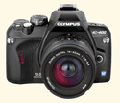
E-400 - 10MP (Discontinued) |
Just when everyone was convinced the next model to be announced in Autumn of 2006 would be the E-1 replacement, Olympus surprised us again with the world's smallest and lightest DSLR; the diminutive E-400. At last Olympus are taking advantage of the 4/3rds promise of smaller DSLR's. Complete with 2 specially designed 'Blue Band' lenses this offering will be popular with those wanting light weight and portability. To see more click the body icon. |
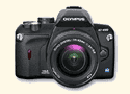
E-410 - 10MP & Live-View (Discontinued) |
More or less identical to the E-400 except this model has a Panasonic imager to facilitate Live View rather than the Kodak of the E-400. There are other slight differences such as a larger buffer and a new RAW compression algorithm. This is the new 'entry level' Olympus DSLR machine. Small, light, portable plus Live-View - this is why Olympus dropped the C-series machines. To see more click the body icon. |
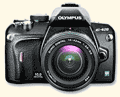
E-420 - 10MP & Live-View |
Almost identical to the E-410, the E-420 offers a slightly larger LCD and a streamlined menu system. Also featured with this cameras release is the 25mm x f2.8 PANCAKE lens. Together they offer the world's smallest DSLR. To see more click the body icon. |
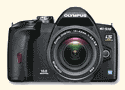
E-510 - 10MP + IS & Live-View (Discontinued) |
As well specified as the E-500 before it but this incarnation is fitted with the Panasonic imager to enable Live-View and built-in Image Stabilization on the sensor, not lens based as we might have expected. However a non-articulating LCD screen reduces the usability of the Live-View facility. Olympus' advanced amateur or intermediate grade model. To see more click the body icon. |
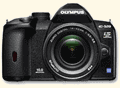
E-520 - 10MP + IS & Live-View |
Almost identical to the E-510 before it but this incarnation has three way Image Stabilization, improved Dynamic Range and subtle Shadow Adjustment Technology for out of the camera JPG improvements in tricky situations. Also enjoys a slightly larger LCD and improved menu system. To see more click the body icon. |
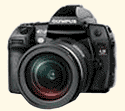
E-3 - 10.1MP + IS & Live-View |
Four years after the release of the E-1 the E-3 arrived October 2007. The new top grade offering has a new Panasonic sensor of 10.1MP, triple processing engines, Twin mode Image Stabilization in body, entirely new viewfinder with 100% coverage & 1.15X magnification, new AF system with 11 cross points, Live View on new two axis LCD panel, 5 fps, new shutter to 1/8000th, flash synch 1/250th, with SWD lenses the fastest AF system in the world and optional twin battery power grip. To see more click the body icon. |
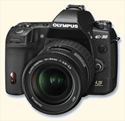
E-30 - 12MP + IS + CDAF & Live-View |
Announced in December 2008 the E-30 is the long awaited 'inbetween' 4/3rds camera occupying the gap between the consumer level E-5XX and the Professional Grade E-X. Taking much of the best from the E-3 and combining it with a new Panasonic 12MP sensor, triple mode Image Stabilization in-body, a new level gauge and some Art Filters the new E-30 offers a new level of Olympus DSLR. It has the multi-poseable LCD panel and a new viewfinder reminiscent of the E-1. To see more click the body icon. |
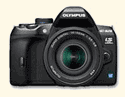
E-620 - 12MP + IS + CDAF & Live-View |
Announced in March 2009 the E-620 is the probable replacement for the E-5XX series. It offers a body size similar to the E-4XX series but with the addition of a larger grip. It boasts a new AF system with 7 AF points and a larger screen than the previous E-5XX machines. With a fully poseable rear screen, Art Filters and Level Gauge it is very well specified. It offers the most customisable menu system of any mid range DSLR. It enjoys higher dynamic range and slightly better high ISO performance than E-4xx & E-5XX cameras. To see more click the body icon. |
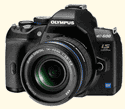
E-600 - 12MP + IS + CDAF & Live-View |
Announced in September 2009 the E-600 is a slightly downgraded version of the E-620. The features removed from the E-600 are backlit buttons, multiple exposures, aspect ratios and IR release. The camera has three fewer art filters. The new camera still enjoys the new AF system with 7 AF points and a larger screen. It still enjoys 3 Art Filters and Level Gauge. Sales are restricted to major retailers only; in UK this means Curry's and PC World. To see more click the body icon. |
LENSES
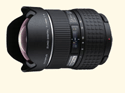
ZD 7-14mm |
To see more click the lens icon. |
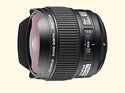
ZD 8mm Fisheye |
A new addition to the mid range or HIGH GRADE lenses from Olympus the 8mm Fisheye will be internationally available in Spring 2006. A diagonal Fisheye lens incorporating 10 elements including 1 ED with close focus to 2cm. For spectacular 180 degree Field of View. (Watch those ears!) To see more click the lens icon. |
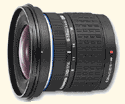
ZD 9-18mm Ultra Wide-angle zoom |
A brand new addition to the budget range or STANDARD GRADE lenses from Olympus, the 9-18mm extreme wide-angle lens will be internationally available in September 2008. The lens is designed to complement the ZD18-180mm offering a remarkable focal length spread of 9-180mm (18-360mm equivalent) in just two carry everywhere lenses. Many have been waiting for an affordable alternative to the fabled and expensive ZD7-14mm. CDAF enabled. To see more click the lens icon. |
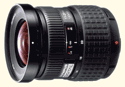
ZD 11-22mm |
This super-wide-angle lens was an early addition to the Zuiko Digital HIGH GRADE lens line up. This lens is an inevitable result of Olympus' decision to run with the 4/3rds standard; meaning there is an inherent XXX factor, or put simply a doubling of the stated focal length compared to 35mm lenses. At its widest end this lens just about reaches the equivalent width of the fabled OM 21mm. To see more click the lens icon. |
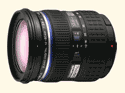
ZD 12-60mm SWD |
This new lens is in the HIGH GRADE range. Is this a replacement for the ZD14-54 AND the ZD11-22mm lenses? The ZD14-54 has attracted some criticism for being an inconsistent performer and there has been speculation about phasing out the well recieved ZD11-22; this lens may well be the reason. Interestingly the lens is Super Wave Drive (SWD) and has mechanical manual focusing. |
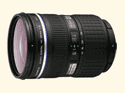
ZD 14-35mm f=2.0 SWD |
SUPER HIGH GRADE lens. Super fast f=2.0 throughout the zoom range. This is the latest addition to the Super High Grade lens stable and underlines Olympus' committment to the E-system at a professional level. Unlike other SHG lenses the 14-35mm is SWD and has innate mechanical manual focusing. It appeared in mid 2008 and received much acclaim by such sites as DXO for its superb resolution. However its AF system has attracted some criticism for being a tad unreliable in low light conditions. Personally I have not found this. To see more click the lens icon. |
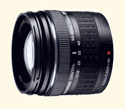
ZD 14-42mm Compact |
In a surprise announcement in September 2006 the E-400 was introduced. Olympus offers two compact and lightweight lenses especially designed for the E-400 in the STANDARD or BUDGET range. The ZD 14-42mm is the 'standard' zoom (see ZD 40-150 for other). These compact lenses are denoted by a 'blue chrome' band which rather looks like the silver ring of the Top Grade Pro models. CDAF enabled. To see more click the lens icon. |
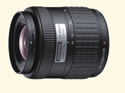
ZD 14-45mm (Discontinued) |
As a direct response to a major criticism of Olympus; their lenses are too expensive, making the E-System less appealing to the amatuer market, the company respond in 2005 with a STANDARD or BUDGET range of lenses, primarily for the E-300. This is the basic zoom offering. Less bright than the higher grade range and not equipped with dust and moisture proofing they do however keep the system price down allowing modest cost entry into DSLR. To see more click the lens icon. |
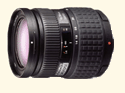
ZD 14-54mm |
To see more click the lens icon. |
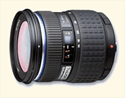
ZD 14-54mm (ll) |
To see more click the lens icon. |
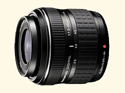
ZD 17.5-45mm (Kit lens only) |
In a further development of the 'economy' or STANDARD or BUDGET range, and designed especially for the new E-500 the 17.5-45mm ZD introduced in September/October 2005 continues the theme. Olympus answer their critics by offering a cheaper DSLR body with an even more affordable standard zoom lens available in certain countries as part of the E-500 SE Kit (Standard Economy). To see more click the lens icon. |
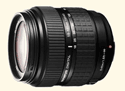
ZD 18-180mm |
In a further development of the 'economy' or STANDARD or BUDGET range, the new 18-180mm ZD introduced in 2006 offers a great 'walkabout' or travelling lens. This lens has received mixed reviews but with such a focal length spread some compromises have been made. Sigma showed a similar 4/3rds fit 18-200 in their development programme, but for unknown reasons this has been dropped. To see more click the lens icon. |
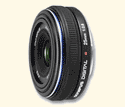
ZD 25mm x F=2.8 |
With the announcement of the E-420 body in early 2008 came this new lens - the first of a new generation of 'PANCAKE' prime lenses from Olympus. Very tiny and slim, this new pancake lens offers a FoV of 50mm (in 35mm terms the old 'standard' lens equivalent). So popular was it that the first batch of production sold out within weeks!! CDAF enabled. To see more click the lens icon. |
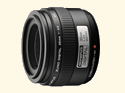
ZD 35mm Macro |
Continuing the 'economy' theme Olympus introduce their new 35mm x f=3.5 ZD Macro lens at the same time as the new E-500 body. This lens sits in their STANDARD or BUDGET range, bringing true Macro imaging to the amatuer market at an affordable price. To see more click the lens icon. |
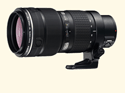
ZD 35-100mm |
To see more click the lens icon. |
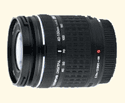
ZD 40-150mm Compact |
The second compact lens especially designed for the E-400. Olympus offers two compact and lightweight lenses especially designed for the new lightweight DSLR E-400, both in the STANDARD or BUDGET range. The ZD 40-150mm is a compact telephoto zoom (see ZD 14-42 for other). These compact lenses are denoted by a 'blue chrome' band which rather looks like the silver ring of the Top Grade Pro models. CDAF enabled. To see more click the lens icon. |
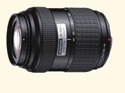
ZD 40-150mm (Discontinued) |
To see more click the lens icon. |
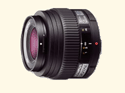
ZD 50mm Macro |
The 50mm ZD Macro lens was part of the original E-System announcement in late 2003. With the 14-54mm, 50-200mm and the 300mm this lens completed the early line-up. The 50mm Macro was the cheapest lens available of the original clutch of lenses, but at £400 it was no give-away! It soon establishes itself with the Macro fraternity for it's exceptionally sharp results. It is designated as HIGH GRADE in the Olympus range. To see more click the lens icon. |
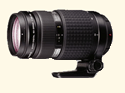
ZD 50-200mm (Discontinued) |
The 50-200mm lens was part of the original E-System announcement in late 2003 and is in the HIGH GRADE range. It has received high acclaim from all its users. A stellar performer with a straight 4 times reach, high levels of native sharpness and a delightful bokeh this lens is truly magnificent. Though not enjoying the fixed aperture of the latest zooms, at f=3.5 at 200mm it is a mile faster than anything OM offered. To see more click the lens icon. |
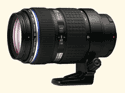
ZD 50-200mm SWD |
The 50-200mm is regarded by many as the best high grade zoom currently offered. This new lens rather confirms that as it has an identical specification but enjoys the new SWD motorised AF system for higher speed focusing and is in the HIGH GRADE range. No more information at present. |
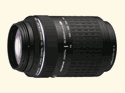
ZD 70-300mm |
A completely new lens falling into the STANDARD or BUDGET grading. It has a massive zoom range which is going to be difficult to handhold without IS found in most of the E-System cameras to date excluding E-4XX series. A little slow for such a long reach. A 'budget' zoom, excellent value. CDAF enabled. No more information at present. |
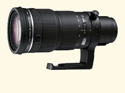
ZD 90-250mm |
To see more click the lens icon. |
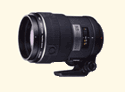
ZD 150mm |
Winner of the 2004 TIPA Best High End Lens Award the SUPER HIGH GRADE 150mm ZD prime telephoto is already renowned by nature/wildlife photographers. At f=2.0, an 11 element contruction, one ED and one super ED element and a 9 bladed aperture the bokeh is superb. Known affectionately as the Baby Tuna. To see more click the lens icon. |
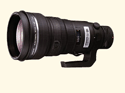
ZD 300mm |
The current ZD Lens flagship. A SUPER HIGH GRADE 2.8 x 300mm (600mm 35mm equivalent) Super Telephoto prime lens. Boasting 3 ED elements, a 13 element construction and a rear mounted drop-in filter system, this is truly a wonderous beast! The 300mm lenses are hand built to order only. Hugely expensive and known as the 'Big Tuna'. To see more click the lens icon. |
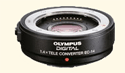
ZD (EC) 1.4 Tele-converter |
To see more click the lens icon. |
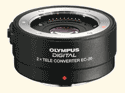
ZD (EC) 2.0 Tele-converter |
A development of the TC1.4, this incarnation offers 2X converter. If the OM system is a guide the 2X will be slightly lesser specified. Will the 2X converter be HIGH GRADE or STANDARD GRADE accessory? With 5? elements and (presumably) offering the same dust and drip proofing enjoyed by the high and super high grade Zuiko Digital lenses. This could be a cheaper option. No more information at present. |
ACCESSORIES
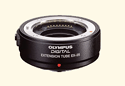
E-System Extension tube 25mm |
Designed to give greater macro capability the 25mm extension tube works primarily with the 50mm Macro ZD. However this tube increases the close focus capability of most ZD lenses and in particular the 50-200mm zoom. To see more click the accessory icon. |
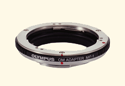
E-System OM to ZD lens mount adapter |
Subject of extraordinary global debate this small adapter ring caused both Olympus and ZD users everywhere major headaches. Olympus could not decide if they should acknowledge they had made such an adapter; then they could not decide to manufacture it commercially; then if they should release it to 4/3rds users; to finally making the decision to give one free with each 4/3rds body sold. If you ewant to mount OMZ's on E-system bodies you'll need one! To see more click the accessory icon. |
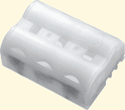
LBH-1 Emergency Battery Holder |
Included as a cheap alternative to a proper BLM-1 battery and charger for those buying the E-500 SE Kit (especially in UK) this accessory got off to a bad start. It holds three CR123A cells and for travelers it's a great option for any E-Camera taking BLM-1 battery. To see more click the accessory icon. |

E-System Flash FL-20 mini unit |
Coming primarily from the Camedia C-series range of compact machines the FL-20 is an all purpose but restricted small, lightweight and pocketable flash unit. Seamless integration with E-System bodies. Limited output, fixed head. Operates on 2 rechargeable NiMH AA's. To see more click the flash icon. |

E-System Flash FL-36 midi unit |
The latest addition to the FL flash range. FL-36 designed alongside the E-300 to offer a more affordable fully integrated flash unit. With swivel and bounce it is very adaptable. Operates on 2 rechargeable NiMH AA's. To see more click the flash icon. |

E-System Flash FL-50 maxi unit |
The flagship FL series flash unit. Full integration with E-system bodies. Total control. Increase/decrease intensity. Full tilt, swivel and bounce. Powerful. Operates on 4 rechargeable NiMH AA's. To see more click the flash icon. |
SIGMA FOURTHIRDS LENSES

Sigma Corporate Logo |
The Japanese lens company Sigma was an early signatory to the 4/3rd's standard. It has recently enhanced its range of DC lenses for the E-system and now deserves a dedicated section on this web site. A start has been made but please be patient. To see more click the SIGMA icon. |
GENERAL INTEREST
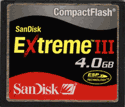
The new generation of high speed cards |
To see more click the compact flash icon. |
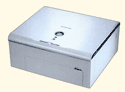
Olympus dye sublimation printer |
To see more click the printer icon. |

Digital Reference Book |
To download the new version (3.22mb) click here. To download the old version (2.24mb) click here. |
|
HOME |
INTRO |
BOOKS |
OLYMPUS CIRCLE |
QUEST |
TOC MEMBERS |
GALLERIES
|
| Posted 26/Feb/2005 14:04 | Copyright © 2004 John Foster |